New Generation of Xilinear Rotary Blow Molding Machine
Bottle Blowing Station:
A dedicated transfer grabber moves the heated preforms into the molds along a defined cam profile. The preforms are first stretch-preblown, followed by high-pressure air blowing to form the final bottle shape.After that the grabbers will transfer the finished bottles out of the mold in the same way.
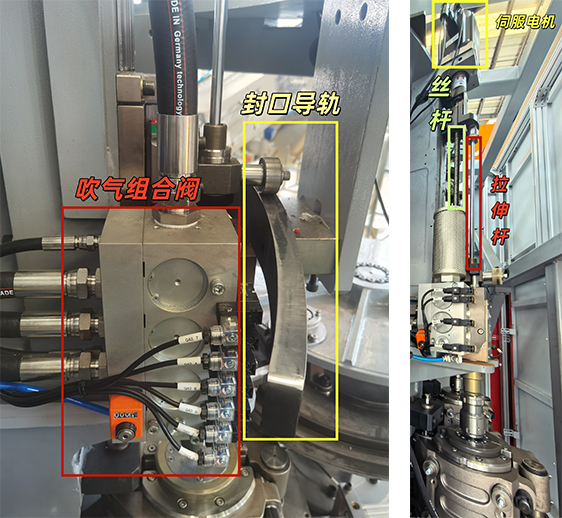
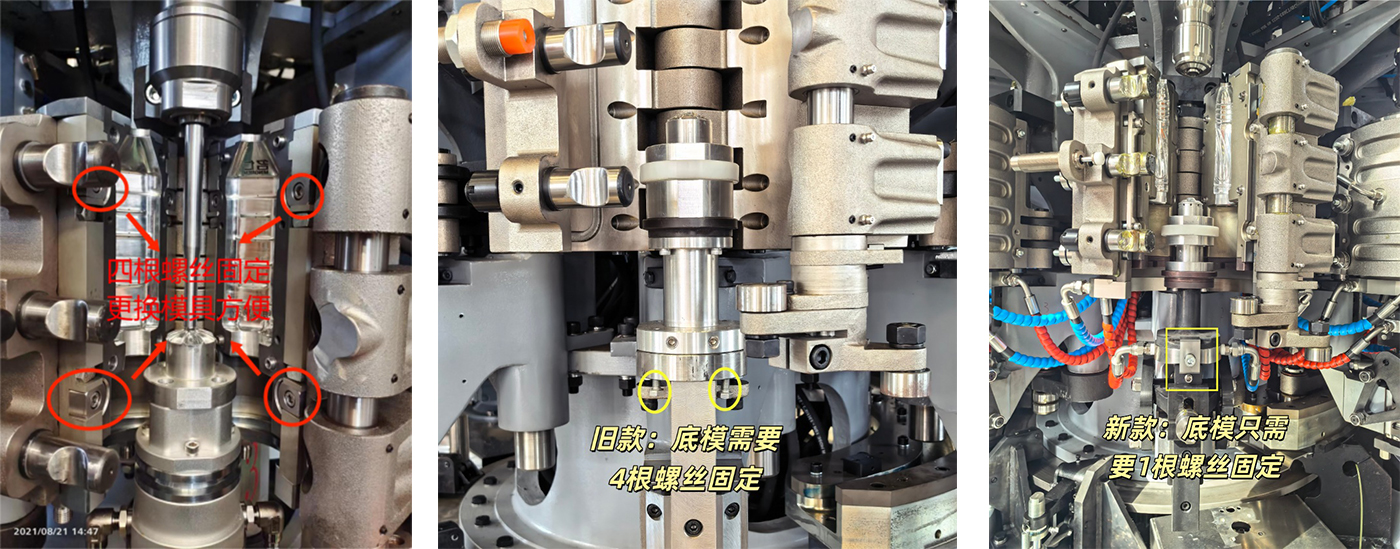
The high-pressure valve group adopts premium components from SMC/Norgren, ensuring stable and reliable blowing performance.The independently developed integrated valve group and mechanical sealing system feature a smaller dead volume compared to similar products, effectively reducing HP compressed air consumption. The mold mounting system enables quick and precise positioning. Combined with cooling water quick connectors equipped with check valves, it allows fast and convenient mold replacement, with a full mold changeover completed in just 30 mins.
Innovative Preform & Bottle Gripper Design
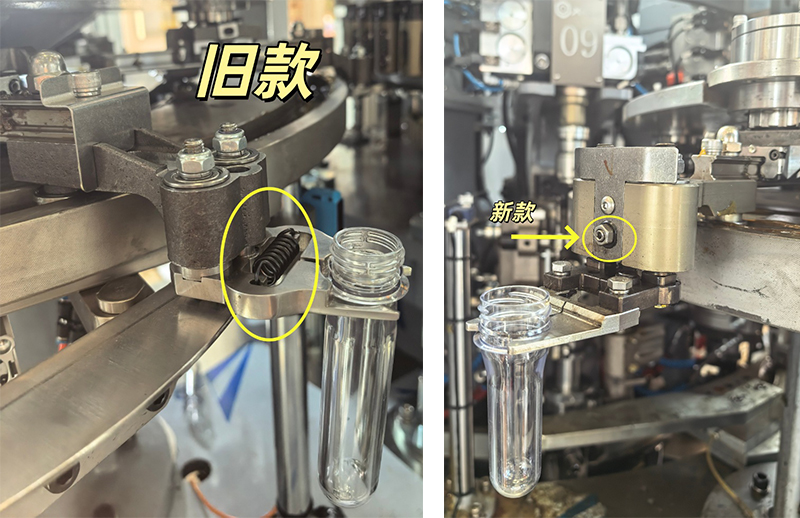
Conventional grippers rely on external tension springs to provide clamping force. The preform/bottle forces the gripper open during gripping and releasing. This design leads to spring fatigue, unstable and uncontrollable clamping force, and the generation of debris, which can compromise food safety and bottle quality.
The new gripper (Xilinear patented design) utilizes an internal spring combined with a lever mechanism to generate clamping force, which can be adjusted according to actual production requirements. At each transfer point of the preform/bottle, the gripper is actively opened via a cam mechanism, avoiding debris generation caused by forced opening in conventional designs.And it's very convenient to replace the gripper, no need to disassemble the spring separately.
Technical Advantages:
The new generation rotary blow molding machine incorporates multiple advanced technologies and patented features, offering high stability, reliability, efficiency, energy savings, and environmental friendliness.
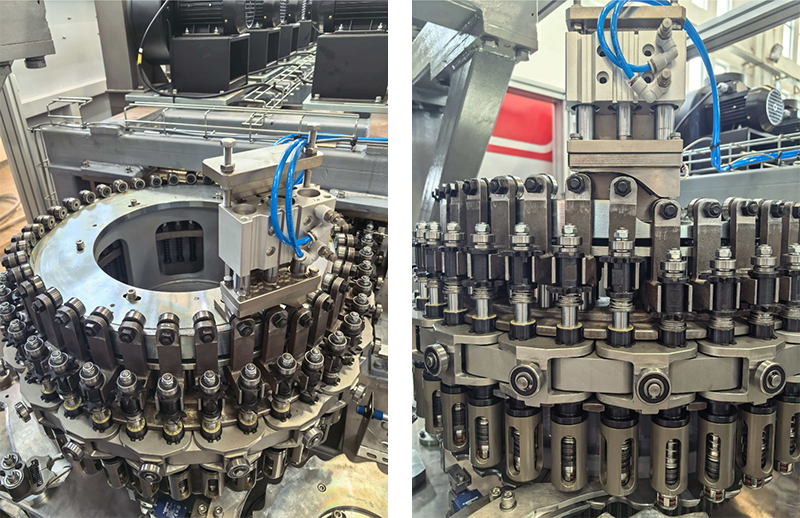
About the preform loading mechanism of the heating unit, we have been upgraded the conventional lever-type insertion/extraction mechanism to a lifting-type system. Specialized cam bearings are used to replace the deep groove ball bearings previously used on the fork mechanism, significantly improving reliability and extending bearing service life.
A self-resetting lifting spring is added to the upper part of the preform insertion head. After insertion, it automatically lifts slightly, ensuring that the preform support ring is positioned above the upper plane of the loading starwheel before disengagement. This allows the preform to remain more stable and vertically aligned on the insertion head after transfer, significantly reducing wobbling during heating. As a result, heat distribution is more uniform and the rejection rate is reduced. After heating, the preform support ring naturally remains above the upper plane of the loading starwheel without external force when entering the discharge starwheel, effectively eliminating the risk of preform jamming.
The blow molding clamping system adopts a rotary shaft locking mechanism, which is simpler, more direct, and more reliable compared to the traditional pin-type locking system.
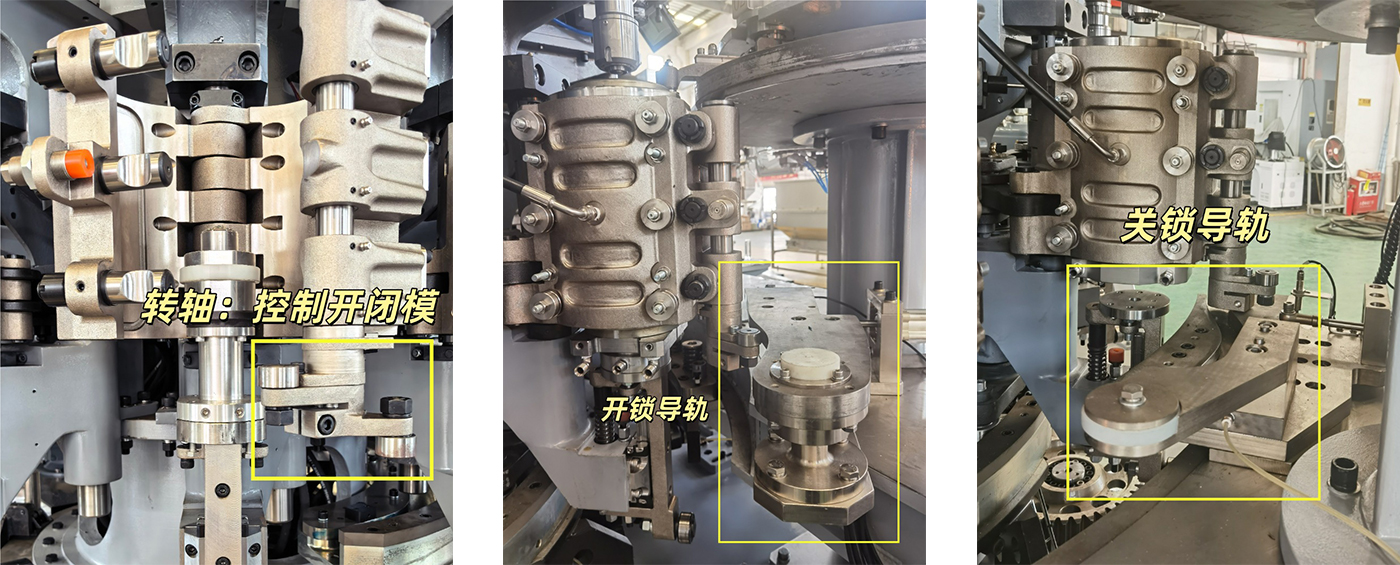
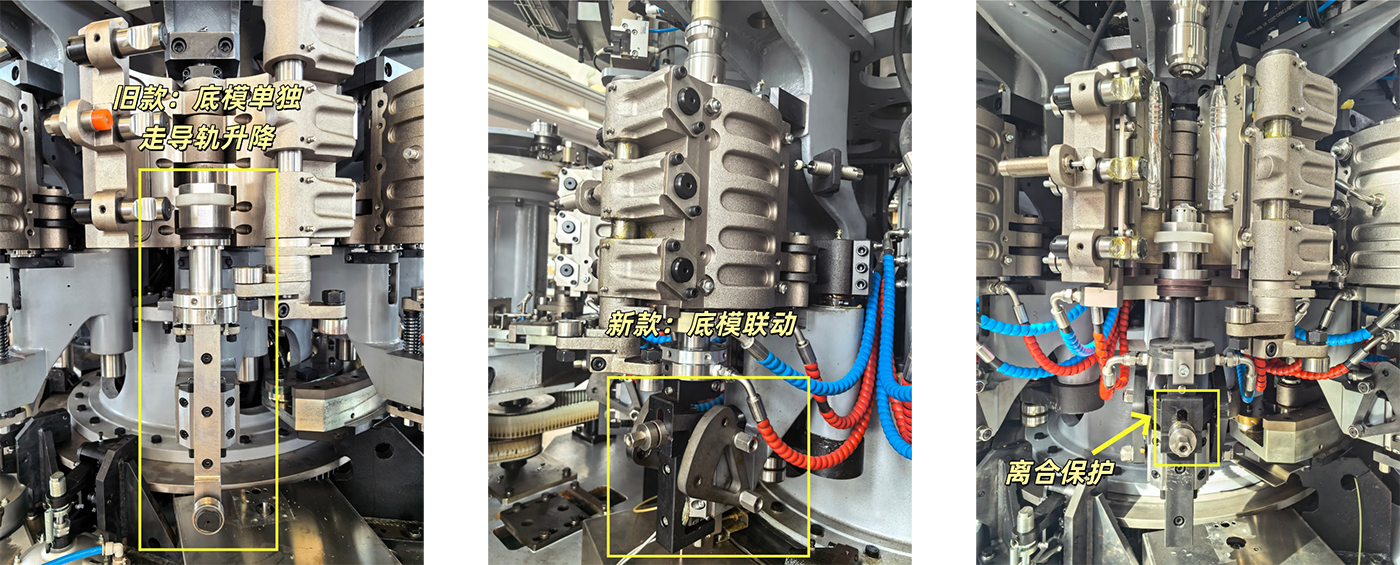
The bottom mold lifting system operates in linkage with the mold opening and closing mechanism. It uses two symmetrically designed guide rails to drive the vertical movement of the bottom mold, ensuring more balanced force distribution. This results in higher synchronization during blowing, enhanced durability, and improved bottle yield.
To prevent damage to the bottom mold linkage mechanism in case of unlocking failure (due to other causes) where the mold cannot be opened, a clutch protection device is incorporated. If the mold frame fails to open, the linkage mechanism would otherwise force the bottom mold downward; at this point, the clutch disengages automatically to protect the linkage system from damage. After troubleshooting and reclosing the mold, the clutch device automatically resets.
The stretching system adopts servo control technology, which offers advantages such as high speed, low noise, and excellent controllability. Compared with pneumatic cylinder-driven stretching, it is more energy-efficient and productive.
The blow molding stage consists of three phases: mechanical sealing, three-stage blowing, and two-stage compressed air recovery.
Mechanical sealing provides superior stability and reliability. The recovered high-pressured air is recycled and reused as pre-blow and intermediate-blow air. During the three stage blowing, the pressure is increased progressively in each stage. Compared with systems without gas recovery, this approach reduces air consumption by 30%-40%, lowers production costs, and significantly decreases exhaust noise.
Mechanical gripper bottle picking and transfer
After blow molding, the mechanical gripper automatically removes the bottles from the mold and passes them through a quality inspection station. Any incompletely formed bottles are automatically rejected and will not be sent to the filling machine, ensuring continuous production. The qualified bottles are then transferred directly to the filling section via air conveyor / star wheel.
Main Features of the Blow Molding Unit
The specially designed blowing system monitors the pressure variation curve during bottle formation in each cavity in real time, providing timely and accurate real‑time parameters for process adjustment. This greatly facilitates operators in fine‑tuning process parameters and ensures stable bottle forming quality。
A cam‑driven transfer mechanism precisely controls the robot handling system, enabling high‑speed pick‑and‑feed of preforms and bottles with proven reliability. The entire sequence – preform picking, preform feeding, bottle picking, and bottle discharging – is fully automated by the manipulator, eliminating intermediate contamination。
The cam mechanism accurately controls the opening and closing of the mold carrier. A special mold‑clamping pressure‑boost system, combined with a robust and compact mold‑carrier structure, ensures reliable sealing under various pressures. Each cavity can have its own blowing parameters independently controlled. The unit features a comprehensive fault diagnosis function, and the blowing pressure is adjustable.
The stretch rod controls the axial stretching of the preform, while the primary and secondary blowing stages control the longitudinal (axial) expansion. By precisely adjusting the primary and secondary blowing parameters, an ideal wall‑thickness distribution of the bottle can be achieved.
Departing from conventional designs, the unit adopts a compact, lightweight coaxial rotating sleeve structure. Two deep‑groove ball bearings are mounted at both ends to ensure concentricity between the outer sleeve and the spindle, thereby minimizing wear on the rotary sealing rings. In addition, a return water channel is incorporated to drain any leakage from the Glyd ring back through the piping, ensuring that the water distribution system remains leak‑free.
The heating system uses short‑wave infrared temperature control. The heating lamps in both the pre‑heating zone and the conditioning zone can be independently adjusted according to process requirements. A real‑time temperature monitoring system guarantees stable and accurate processing.
The cooling water channels and the preform tube air‑cooling system provide effective protection for the bottle neck while preventing excessive temperature build‑up on the outer wall of the preform. Compared with other similar systems, our heating system saves 10‑20% in energy consumption, delivering significant energy savings.
An exhaust gas recovery system (available upon customer request) is incorporated in the pneumatic circuit, which can save 30‑40% of air consumption, thereby reducing energy use and lowering operating costs.
Process parameters – such as heating temperature and blowing time – can be preset according to different preform and bottle types. When switching between preform or bottle styles, simply recalling the stored recipe ensures smooth production.
An automatic lubrication system periodically supplies oil to the machine as needed, ensuring adequate maintenance while reducing manual labor.
Mold assembly is simple and quick; molds can be changed within the shortest time (less than half an hour), minimizing downtime and enhancing overall production efficiency.
The user-friendly design makes complex industrial control operations intuitive and easy for operators. The high‑resolution HMI and multi‑language interface options cater to users in different regions.
The system features real‑time monitoring, comprehensive fault alarms with prompt and help messages, and flexible and convenient parameter setting to meet various process requirements.
Upon customer request, the entire system can be accessed remotely via Ethernet for maintenance and support.
The blow molds are manufactured from high-quality aluminum alloy conforming to US standards, with a special hardening treatment applied to the surface, ensuring long mold service life.
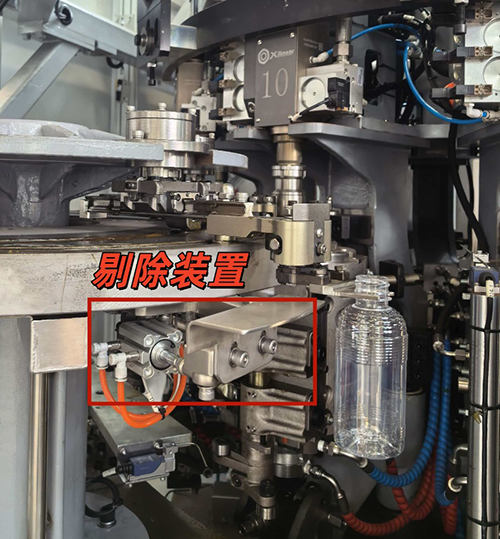
A jamming detection device is installed at the star wheel (preform inlet dial). In the event of a preform jam, the jammed preform is automatically ejected; after the abnormal preform is removed, the device automatically resets itself.
To ensure safety, the Blow Molding Machine is equipped with a robust and reliable safety door system, together with audible/ visual alarm devices, providing maximum protection for operating personnel.

Comments
Post a Comment